
After six months of study required by the Dodd-Frank Act, the Securities and Exchange Commission (SEC) recently announced that all advisors, including brokers, should be held to a fiduciary standard because investors already assume their brokers are acting in their best interests. “Retail customers should not have to parse through legal distinctions to determine whether the advice they receive was provided in accordance with their expectations,” the SEC study noted.
Response was quick and positive from the Securities Industry and Financial Markets Association (SIFMA): “We support a uniform fiduciary standard of care for broker-dealers and investment advisers, and upon initial review we believe that the SEC has appropriately articulated a workable comprehensive approach for personalized investment advice for retail customers.” SIFMA further commended the SEC for not favoring one business model over another and asked the Commission to issue guidance to help firms enact this new standard.
I have long argued that brokers and investment advisors should be governed by a comparable standard of care. The SEC report is a step in the right direction, but does not specify a deadline for everyone to adopt the fiduciary standard. What’s more, it’s also unclear if the SEC will now re-define what it means to be a fiduciary and put your clients’ needs ahead of your own – in all situations. Also, it’s still unclear what organization will be charged with oversight and enforcement. In spite of all their work in the fiduciary debate, the SEC has instructed Congress it doesn’t have the resources to oversee advisors, noting that the best option would be for a self-regulatory organization like FINRA to serve in that capacity.
As we work toward changing industry definitions and regulations, those of us who have always worked as a fiduciary and puts clients’ needs first, continue to insist that the investing public deserves nothing less.
Monday, February 21, 2011

Friday, February 18, 2011
TD Ameritrade Conference
Tim and I attended the 2011 TD Ameritrade Conference in San Diego earlier this month. There were over 60 educational or keynote speakers to see and hear. I thought I would briefly share a few highlights from six of the sessions I attended.
General Colin L. Powell
General Powell was the conference keynote speaker. He was a last minute replacement for Former Prime Minister Tony Blair who was called to Egypt as a result protests and unrest in that country. Tony Blair brought a round of laughter from the crowd of over 2,500 when he said in a recorded message that he thought he would tackle something easy like peace in the Middle East after he retired as prime minister.
Powell was humorous and thoughtful as he shared experiences from his career and life. Powell shared his thoughts about President Reagan's optimism in America and his belief in Americans and wished he "could put all of Reagan's optimism in a bottle and pour it over the heads of politicians in Washington."
I loved the story of his favorite hot dog vendor in New York City and how he would always stop to get a hot dog when he was in public service. Powell shared that when he was in New York City after he left public life he stopped to get a hot dog. After pulling cash from his wallet to pay for the hot dog, the vendor, who came to this country 40 years before, refused to take his money and told Powell the following: "I know who you are. You are Colin Powell. I've been paid. America has paid me. You paid me with your public service. I have taken the opportunity that you have given me, and I am grateful."
Professor Jeremy Siegel
Dr. Siegel is a professor at the University of Pennsylvania's Wharton School of Finance and author of Stocks for the Long Run. He was very dynamic and shared some charts and thoughts.
One chart showed what $1 after inflation would have grown to in various asset classes from 1802 through 2010. It was surprising to see that Gold grew from $1 to $4.02 and U.S. Stocks grew from $1 to $699,088. He believes that "people who recently bought gold are going to be disappointed in five years."
He also showed a chart of U.S. stocks going all the way back to the 1800s. This chart showed a trend line for U.S. stock prices going back to the 1850s with annual price fluctuations above and below the line. If stock prices were above or below the trend line during various years, the prices were eventually drawn back to the trend line. Siegel believes that as of December 31, 2010, the U.S. was 20% below it's long term trend. During the Financial Crisis and Great Recession the U.S. stock market fell to 39.4% below the trend line--the fifth largest deviation during this period of time.
Siegel shared many other statistics but it was clearly obvious that he believed in "Stocks for the Long Run."
Alan Simpson and Erskine Bowles
Former Senator Alan Simpson and former White House Chief of Staff Erskine Bowles shared their experiences and thoughts as co-chairs of the National Commission on Fiscal Responsibility and Reform. Simpson started the discussion by saying they had 14 reasons to inject themselves into the deficit-reduction debate. "He [Bowles] has eight grandchildren and I have six."
According to Simpson and Bowles balancing the budget is a matter of addressing the substantive areas of Medicare, Medicaid, Social Security and defense. Simpson said, “If you don’t cut these, you have to cut everything else by 75%.”
The Commission’s report addresses getting rid of loopholes, broadening the base and simplifying the tax code. They believe that by getting rid of the $1.1 trillion of earmarks in the tax code, “we can take the rates to 8 percent up to $70,000, 14 percent up to $210,000 and 23 percent above that, with a corporate tax rate of 26 percent.” At that point, they agree, America will again be a great place to start and grow a business.
Craig Alexander
TD Ameritrade Chief Economist Craig Alexander shared his insights. He reminded us that two years ago the media was talking 24/7 about the long-term global depression and failed to predict we would be where we are today.
He made the point that "we are a year and a half into recovery but consumers and businesses clearly don't feel like they've reached the far end of the valley." He said said it typically takes twice as long to recover from a financial crisis than it would take from a normal recession.
He felt that inflation would not be an issue for several years due to the huge overhang of inventory at the present time. But he thought the job market would continue to disappoint since you need 200,000 new jobs each month to keep unemployment from rising. And with the people leaving the labor market the REAL unemployment rate was closer to 16%. However, he was not concerned about unemployment as a predictor of the economy since unemployment is a lagging indicator of the economy and stock market.
Alexander said the consensus among economists is for 3% growth of U.S. GDP this year and next year. However, Alexander felt this was too conservative and was projecting a 3.5% to 4% growth.
For the most part, Alexander agree with Professor Siegel and felt that investors who are not participating in the market will be kicking themselves.
Dewitt Jones
We also had the privilege of listening to Dewitt Jones, a motivational speaker and former photographer for National Geographic. What made him unique was that he shared his photographs and stories behind the photographs as he spoke on his theme of "falling in love with the world" and "celebrating what is best in the world."
If you ever have the chance to listen to him, don't pass on it. In the meantime, you can see many of his beautiful photographs by clicking on this web site.
Andy Hill
Any Hill shared his view for life successes and happiness based upon principles he learned from Coach John Wooden. Andy was a member of three consecutive NCAA Championship basketball teams under the guidance of Coach Wooden. Any later served as President of CBS Productions from January 1991 through April 1996 and was responsible for successful shows including Touched by an Angel, Dr. Quinn: Medicine Woman, Walker Texas Ranger, etc.
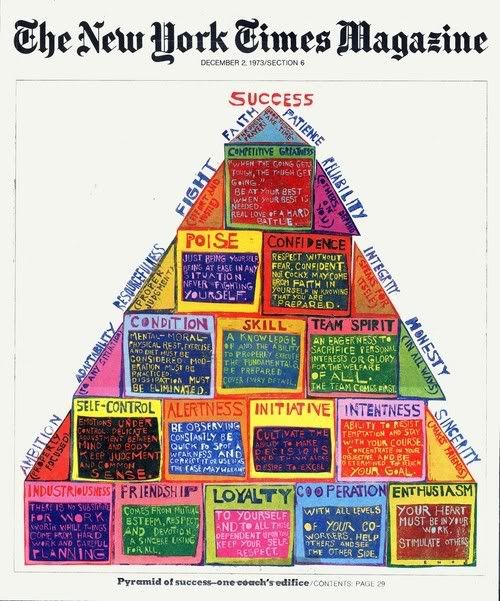
I enjoyed learning about Coach Wooden's pyramid of success and used it to inspire boys to be men and better citizens. I have included it below:

General Colin L. Powell
General Powell was the conference keynote speaker. He was a last minute replacement for Former Prime Minister Tony Blair who was called to Egypt as a result protests and unrest in that country. Tony Blair brought a round of laughter from the crowd of over 2,500 when he said in a recorded message that he thought he would tackle something easy like peace in the Middle East after he retired as prime minister.
Powell was humorous and thoughtful as he shared experiences from his career and life. Powell shared his thoughts about President Reagan's optimism in America and his belief in Americans and wished he "could put all of Reagan's optimism in a bottle and pour it over the heads of politicians in Washington."
I loved the story of his favorite hot dog vendor in New York City and how he would always stop to get a hot dog when he was in public service. Powell shared that when he was in New York City after he left public life he stopped to get a hot dog. After pulling cash from his wallet to pay for the hot dog, the vendor, who came to this country 40 years before, refused to take his money and told Powell the following: "I know who you are. You are Colin Powell. I've been paid. America has paid me. You paid me with your public service. I have taken the opportunity that you have given me, and I am grateful."
Professor Jeremy Siegel
Dr. Siegel is a professor at the University of Pennsylvania's Wharton School of Finance and author of Stocks for the Long Run. He was very dynamic and shared some charts and thoughts.
One chart showed what $1 after inflation would have grown to in various asset classes from 1802 through 2010. It was surprising to see that Gold grew from $1 to $4.02 and U.S. Stocks grew from $1 to $699,088. He believes that "people who recently bought gold are going to be disappointed in five years."
He also showed a chart of U.S. stocks going all the way back to the 1800s. This chart showed a trend line for U.S. stock prices going back to the 1850s with annual price fluctuations above and below the line. If stock prices were above or below the trend line during various years, the prices were eventually drawn back to the trend line. Siegel believes that as of December 31, 2010, the U.S. was 20% below it's long term trend. During the Financial Crisis and Great Recession the U.S. stock market fell to 39.4% below the trend line--the fifth largest deviation during this period of time.
Siegel shared many other statistics but it was clearly obvious that he believed in "Stocks for the Long Run."
Alan Simpson and Erskine Bowles
Former Senator Alan Simpson and former White House Chief of Staff Erskine Bowles shared their experiences and thoughts as co-chairs of the National Commission on Fiscal Responsibility and Reform. Simpson started the discussion by saying they had 14 reasons to inject themselves into the deficit-reduction debate. "He [Bowles] has eight grandchildren and I have six."
According to Simpson and Bowles balancing the budget is a matter of addressing the substantive areas of Medicare, Medicaid, Social Security and defense. Simpson said, “If you don’t cut these, you have to cut everything else by 75%.”
The Commission’s report addresses getting rid of loopholes, broadening the base and simplifying the tax code. They believe that by getting rid of the $1.1 trillion of earmarks in the tax code, “we can take the rates to 8 percent up to $70,000, 14 percent up to $210,000 and 23 percent above that, with a corporate tax rate of 26 percent.” At that point, they agree, America will again be a great place to start and grow a business.
Craig Alexander
TD Ameritrade Chief Economist Craig Alexander shared his insights. He reminded us that two years ago the media was talking 24/7 about the long-term global depression and failed to predict we would be where we are today.
He made the point that "we are a year and a half into recovery but consumers and businesses clearly don't feel like they've reached the far end of the valley." He said said it typically takes twice as long to recover from a financial crisis than it would take from a normal recession.
He felt that inflation would not be an issue for several years due to the huge overhang of inventory at the present time. But he thought the job market would continue to disappoint since you need 200,000 new jobs each month to keep unemployment from rising. And with the people leaving the labor market the REAL unemployment rate was closer to 16%. However, he was not concerned about unemployment as a predictor of the economy since unemployment is a lagging indicator of the economy and stock market.
Alexander said the consensus among economists is for 3% growth of U.S. GDP this year and next year. However, Alexander felt this was too conservative and was projecting a 3.5% to 4% growth.
For the most part, Alexander agree with Professor Siegel and felt that investors who are not participating in the market will be kicking themselves.
Dewitt Jones
We also had the privilege of listening to Dewitt Jones, a motivational speaker and former photographer for National Geographic. What made him unique was that he shared his photographs and stories behind the photographs as he spoke on his theme of "falling in love with the world" and "celebrating what is best in the world."
If you ever have the chance to listen to him, don't pass on it. In the meantime, you can see many of his beautiful photographs by clicking on this web site.
Andy Hill
Any Hill shared his view for life successes and happiness based upon principles he learned from Coach John Wooden. Andy was a member of three consecutive NCAA Championship basketball teams under the guidance of Coach Wooden. Any later served as President of CBS Productions from January 1991 through April 1996 and was responsible for successful shows including Touched by an Angel, Dr. Quinn: Medicine Woman, Walker Texas Ranger, etc.
I enjoyed learning about Coach Wooden's pyramid of success and used it to inspire boys to be men and better citizens. I have included it below:
I also loved the following poem that Coach Wooden would often recite:
No written word, no spoken plea
Can teach our youth what they should be,
Nor all the books on all the shelves.
It's what the teachers are themselves.
Monday, February 14, 2011
Qualified Charitable Distributions
Perhaps lost in all the posturing about what would become of the Bush tax cuts was a valuable extension for qualified charitable distributions. The 2010 Tax Relief Act extended the tax-free distributions from Individual Retirement Accounts (IRAs) for charitable purposes through 2011, i.e., Qualified Charitable Distributions (QCDs).
Briefly, we all know distributions from IRAs must be included in gross income in the year of distribution, and income taxes must be paid on the taxable portion of distributions. A QCD allows IRA owners and beneficiaries age 70½ and older to make tax-free distributions of otherwise taxable dollars from traditional IRAs to qualified charitable organizations. These distributions are also allowed to be made from SEP IRAs and SIMPLE IRAs as long as no employer contributions were made for the same tax year. These QCDs are limited to $100,000 per year, per IRA owner or beneficiary, and the check has to be payable directly to the eligible charity.
I will be sharing more details about this excellent charitable planning opportunity in the coming months. If you are interested in learning more, please consult your financial advisor.
Briefly, we all know distributions from IRAs must be included in gross income in the year of distribution, and income taxes must be paid on the taxable portion of distributions. A QCD allows IRA owners and beneficiaries age 70½ and older to make tax-free distributions of otherwise taxable dollars from traditional IRAs to qualified charitable organizations. These distributions are also allowed to be made from SEP IRAs and SIMPLE IRAs as long as no employer contributions were made for the same tax year. These QCDs are limited to $100,000 per year, per IRA owner or beneficiary, and the check has to be payable directly to the eligible charity.
I will be sharing more details about this excellent charitable planning opportunity in the coming months. If you are interested in learning more, please consult your financial advisor.
Monday, February 7, 2011
Power to the People: U.S. Shareholders Have a Say on Corporate Pay
Starting on January 21, 2011, shareholders of U.S. companies will be able to give a thumbs up or a thumbs down to executive pay packages. You may remember that the "say on pay" vote was first introduced as a safeguard when U.S. financial institutions dubbed "too big to fail" received federal bailout funds thanks to the Troubled Asset Relief Program (TARP). Today, the Dodd-Frank Wall Street Reform and Consumer Protection Act requires that all public companies conduct say-on-pay votes at least once every three years. According to Say on Pay: Will U.S. Shareholders Give Executives the Thumbs Up on Compensation?, an article published in the online business journal Knowledge@Wharton, shareholders will also be asked for their views on golden parachute awards after a merger or acquisition and pension funds and other large institutional investors that cast ballots must disclose how they voted.
In the article, Wayne Guay, a Wharton accounting professor who consults on executive compensation plans, questions whether the new voting system can help improve pay packages. In his view, any analysis of pay packages by institutional investors would be trivial when compared to the work of various corporate boards. Interestingly, the article includes data from Towers Watson, a compensation advisory firm, that backs Professor Guay. According to Towers Watson, of the companies that voluntarily adopted say-on-pay voting in advance of Dodd Frank, only three companies failed to receive majority support for their compensation programs in 2010, and no company failed to receive majority support in 2009.
In my view, Wharton Professor Micahel Useem sums the pros and cons of the new law nicely. While he says the big benefit will be the increased transparency into the design of executive pay structures, he cautions that if boards become too focused on compensation issues, they may fail to dedicate the time necessary for long-term corporate planning.
In the article, Wayne Guay, a Wharton accounting professor who consults on executive compensation plans, questions whether the new voting system can help improve pay packages. In his view, any analysis of pay packages by institutional investors would be trivial when compared to the work of various corporate boards. Interestingly, the article includes data from Towers Watson, a compensation advisory firm, that backs Professor Guay. According to Towers Watson, of the companies that voluntarily adopted say-on-pay voting in advance of Dodd Frank, only three companies failed to receive majority support for their compensation programs in 2010, and no company failed to receive majority support in 2009.
In my view, Wharton Professor Micahel Useem sums the pros and cons of the new law nicely. While he says the big benefit will be the increased transparency into the design of executive pay structures, he cautions that if boards become too focused on compensation issues, they may fail to dedicate the time necessary for long-term corporate planning.
Monday, January 31, 2011
You Deserve a Fiduciary
Who can you trust to give you the best possible financial advice? Interestingly, during times of personal crisis such as job loss, divorce or death of a spouse, the vast majority of Americans turn to family and friends rather than financial advisors, according to a recent survey from AARP Financial.
I understand that impulse. It is natural to turn to those you know care most about you in your time of need. However, as is the case when you require medical care or legal advice, or even home maintenance, it is crucial to work with someone who is well-informed in addition to being well intentioned. Ironically, although the combination of expertise and care is especially necessary for your finances, it can be exceedingly difficult to find. That is, of course, unless your financial advisor is a fiduciary who is bound to put your needs and interests first, in all cases.
You might assume that all “financial advisors,” like attorneys and CPAs, have a fiduciary duty to act in the best interests of their clients. That is not the case. When I meet with prospective clients, they are surprised to learn that there are professional financial advisors who practice at a lower standard.
In fact, federal and state law holds only Registered Investment Advisors (RIAs) to a Fiduciary Standard that requires those advisors to act solely in the best interest of the client, even if that interest is in conflict with the advisor’s own financial interest. Further, RIAs must disclose any conflict, or potential conflict, to the client prior to and throughout a business engagement, as well as adopt a Code of Ethics and fully disclose how they are compensated.
Bernhardt Wealth Management is a Registered Investment Advisor and my team and I are proud to call ourselves fiduciaries. Investors should accept nothing less from advisors managing their money.
Monday, January 24, 2011
What is One of Your Greatest Life Experiences?
One of the greatest rewards my team and I receive is the knowledge that by serving as our clients' personal chief financial officer our clients have more time to to spend with their family, focus on their business and/or profession, give back to their community or pursue other things that are important to them. It is our hope that they can then lead a fuller life as a result of our service. Or as Horace said "“Carpe diem! Rejoice while you are alive; enjoy the day; live life to the fullest; make the most of what you have.”
What is one of your greatest life experiences? I recently had one of the best life experiences I have ever had. I hiked four days and 52.6 miles in the Grand Canyon.
On January 5th I hiked down the South Kaibab Trail to Phantom Ranch. The photo below is me on the South Rim of the Grand Canyon at the South Kaibab Trailhead.

On January 6th, I left Phantom Ranch and hiked part way up the North Kaibab Trail. On my way back I stopped to have lunch at Ribbon Falls.


A couple in their 60s stopped me as I left the Grand Canyon and asked questions about my experience. I answered all of their questions and could not say enough good things about my four days in the Grand Canyon. Her final comment to me as we parted was “the glow on your face says it all.”
The combination of the beauty and grandeur of the Grand Canyon plus not having access to news, television, internet, cell phone service, etc. made this one of my favorite experiences. What is one of your greatest life experiences?
I invite you to post your comments to this blog and list one or more of your greatest experiences. For some I am sure it will be a marriage or birth of a child. For others it may be an award or achievement. I would love to learn what is one of your greatest experiences and hope you will take the time to post your comments.
You can click on the following links for Album #1 and Album #2 if you want to see other photos and my comments about each photo.
And may each day of your life be lived to its fullest!
What is one of your greatest life experiences? I recently had one of the best life experiences I have ever had. I hiked four days and 52.6 miles in the Grand Canyon.
On January 5th I hiked down the South Kaibab Trail to Phantom Ranch. The photo below is me on the South Rim of the Grand Canyon at the South Kaibab Trailhead.

On January 6th, I left Phantom Ranch and hiked part way up the North Kaibab Trail. On my way back I stopped to have lunch at Ribbon Falls.

On January 7th, I hiked part of the Clear Creek Trail from Phantom Ranch.

On January 8th, I left Phantom Ranch at 6:00 AM to begin my hike out of the Grand Canyon on the Bright Angel Trail. Here is a photo of me at the Bright Angel Trailhead after I reached the South Rim.

A couple in their 60s stopped me as I left the Grand Canyon and asked questions about my experience. I answered all of their questions and could not say enough good things about my four days in the Grand Canyon. Her final comment to me as we parted was “the glow on your face says it all.”
The combination of the beauty and grandeur of the Grand Canyon plus not having access to news, television, internet, cell phone service, etc. made this one of my favorite experiences. What is one of your greatest life experiences?
I invite you to post your comments to this blog and list one or more of your greatest experiences. For some I am sure it will be a marriage or birth of a child. For others it may be an award or achievement. I would love to learn what is one of your greatest experiences and hope you will take the time to post your comments.
You can click on the following links for Album #1 and Album #2 if you want to see other photos and my comments about each photo.
And may each day of your life be lived to its fullest!
I Invite You to Visit ExecutiveLeadersRadio.com
As a farm boy from Nebraska I grew up in a close knit community where your word was your bond. A personal connection to both my community and my work has always been integral to my happiness. Early in my career when I was an accountant, I changed professions primarily because I did not have self-satisfaction in my work. When I transitioned to the wealth management industry, I realized it was the satisfaction I gained from interacting with clients one-on-one, and doing all I could to help them reach their goals that was missing from my previous work.
Today, I enjoy trusting and productive long-term relationships with a wonderful group of clients. And through my involvement with Executive Leaders Radio, I get to help share the inspirational stories and words of wisdom of successful business owners and executives. We hope their stories inspire and motivate young men and women.
You may want to encourage the young people you know to listen to past broadcasts of the show at Executive Leaders Radio. And please feel free to contact me if you would like to recommend a business owner or executive we should interview on the program.
Today, I enjoy trusting and productive long-term relationships with a wonderful group of clients. And through my involvement with Executive Leaders Radio, I get to help share the inspirational stories and words of wisdom of successful business owners and executives. We hope their stories inspire and motivate young men and women.
You may want to encourage the young people you know to listen to past broadcasts of the show at Executive Leaders Radio. And please feel free to contact me if you would like to recommend a business owner or executive we should interview on the program.
Monday, January 17, 2011
What You Don’t Know Can Hurt You
The Role of Financial Literacy in Determining Retirement Plans by Robert Clark, Melinda Sandler Morrill, and Steven G. Allen is the latest publication in the National Bureau of Economic Research’s Working Papers series. Based on responses from more than 1,500 workers nearing retirement at three large U.S. companies, the researchers arrive at a sobering conclusion. They state, “Although retirement-related decisions will affect workers’ well-being for the remainder of their lifetimes, many do not possess enough basic financial knowledge to confidently make optimal choices.”
Just where do the employees fall short? While nearly all of the workers surveyed were covered by defined benefit pension plans, 56% didn’t know what their pension would be once they retired. And when asked about national retirement programs like Social Security or Medicare, workers got only 50% of the answers correct. Alarming, just 37%, knew 66 was the age that they could retire with full benefits.
Make this year the year you take maximum advantage of your retirement plan at work. Contribute all you can to your 401(k), at least enough to qualify for any company matching funds. If you receive a raise, increase your contributions. This year’s plan limits are $16,500, or $22,000 if you're over age 50. If you are self-employed, or have self-employment income from consulting work or a hobby, there are additional retirement savings vehicles you can use, including Individual 401(k) plans, SEP-IRAs, SIMPLE IRAs, or Keoghs.
You should also consult with an independent financial advisor if you have questions about your retirement plan.
Just where do the employees fall short? While nearly all of the workers surveyed were covered by defined benefit pension plans, 56% didn’t know what their pension would be once they retired. And when asked about national retirement programs like Social Security or Medicare, workers got only 50% of the answers correct. Alarming, just 37%, knew 66 was the age that they could retire with full benefits.
Make this year the year you take maximum advantage of your retirement plan at work. Contribute all you can to your 401(k), at least enough to qualify for any company matching funds. If you receive a raise, increase your contributions. This year’s plan limits are $16,500, or $22,000 if you're over age 50. If you are self-employed, or have self-employment income from consulting work or a hobby, there are additional retirement savings vehicles you can use, including Individual 401(k) plans, SEP-IRAs, SIMPLE IRAs, or Keoghs.
You should also consult with an independent financial advisor if you have questions about your retirement plan.
Monday, January 10, 2011
Now Law: Estate Tax Rate and Exclusion
I have previously written on my amazement that Congress allowed the estate tax to lapse last year and of the many plans put forth to reinstate the death tax. With the signing of The Tax Relief, Unemployment Insurance Reauthorization, and Job Creation Act of 2010, the estate tax has been reinstated for 2011 and 2012 at a maximum rate of 35% with a $5 million per person exemption. In 2009, a 45% maximum tax rate was accompanied by a $3.5 million exclusion. Beginning in 2013, however, the exclusion drops to $1 million per person and the estate and gift tax rate increase to 55% – that is, of course, unless further legislation is enacted.
Interestingly, the new law retroactively reinstates estate taxes for 2010 at the rate of 35%. However, executors of estates of decedents who died in 2010 are permitted a taxation choice. They can distribute assets to heirs estate-tax-free but with a carryover basis (generally the original purchase price), or step up the basis to the market value (generally at time of death) and pay the current 35% rate on anything above the $5 million exemption. A step-up in basis means the value of an appreciated asset is readjusted at a higher market value for tax purposes upon inheritance versus what the value of the asset was when it was originally purchased.
Because this is a complex decision for estates over $5 million with highly appreciated assets, be sure to contact your financial advisor, attorney, or tax advisor for advice.
Other notable estate tax changes for 2011 include:
Interestingly, the new law retroactively reinstates estate taxes for 2010 at the rate of 35%. However, executors of estates of decedents who died in 2010 are permitted a taxation choice. They can distribute assets to heirs estate-tax-free but with a carryover basis (generally the original purchase price), or step up the basis to the market value (generally at time of death) and pay the current 35% rate on anything above the $5 million exemption. A step-up in basis means the value of an appreciated asset is readjusted at a higher market value for tax purposes upon inheritance versus what the value of the asset was when it was originally purchased.
Because this is a complex decision for estates over $5 million with highly appreciated assets, be sure to contact your financial advisor, attorney, or tax advisor for advice.
Other notable estate tax changes for 2011 include:
- New portability rules that allow any unused exemption to be passed to a surviving spouse. Therefore, a married couple can exempt up to $10 million.
- A new lifetime gift tax exemption of $5 million per person ($10 million per couple.) Taxable gifts made in 2011 and 2012 will be taxed at the rate of 35%.
- A generation skipping transfer tax (GSTT) exemption of $5 million per person ($10 million per couple) with a 35% tax rate. Note: The GSTT is not portable.
Monday, January 3, 2011
Ring in the New Year with a Financial Check-up
January is a great time for an annual financial check-up. These five steps can help you plan for your future:
- Construct your balance sheet: List assets held in brokerage and savings accounts, college savings and 401(k) plans, insurance policies, and real estate. Then, list your liabilities including your mortgage, auto loans, and credit cards. This exercise may generate a to-do list. Maybe you’ll want to up your 401(k) contributions or attack consumer debt.
- Update your budget: You need to plan for any life changing events on the horizon--the birth of a child, a new home, children going to college so you can continue to fund what matters most to you.
- Check your emergency fund: In the wake of the recession and with unemployment still high, it’s absolutely necessary to keep six months of your current income in a liquid, interest-bearing account to manage unexpected expenses or a job loss. If you dipped into your emergency fund last year, replenish your account.
- Check your credit score: Routine credit checks uncover costly mistakes and can protect you from identity theft. You can request your report for free, once a year. Contact any of the three major credit agencies: Equifax, 800-685-1111; Experian, 1-888-397-3742; or TransUnion, 800-888-4213 or visit them online.
- Review your legal documents: Take a look at your will (or trust), power of attorney, and advance medical directive. Also, as retirement accounts and life insurance normally pass outside of your will, you’ll want to check that your named beneficiaries still reflect your wishes.
Subscribe to:
Posts (Atom)


 Posts
Posts


