
Last week on March 9, 2011, the world celebrated the two-year anniversaryof the low point in the global markets, the point of maximum pain and panic following the 2008 financial crisis and Great Recession.
On March 9, 2009, the S&P 500 Index had fallen to its low of 676.53, which is about where it had been almost 13 years before--on June 10th and October 3rd of 1996 it closed at 672.16 and 692.78, respectively. On March 9, 2011, the S&P 500 Index closed at 1321.15--a 95% increase from its low two years earlier but still down 18% from its all time high of 1565.15 on October 9, 2007. During the same two year period of time the Russell 2000 Index--an index that tracks small cap stocks--rose almost 140% from 343.26 to 821.19.
If you look back at the economic forecasts and market reports in March of 2009, you will not find a prediction that the markets would recover as they have. There was even some doubt whether the U.S. economy would survive intact, and the most common prediction was deflation, continued recession and more downside in the stock markets.
In retrospect, this most frightening time was the ideal time to shove all the chips on the table and bet everything on a stock market recover--but who had the intestinal fortitude for that? After the losses that virtually all investors had sustained, no matter where they had deployed their assets, few had the stomach, or the heart, to bet on a robust recovery. This is a terrific lesson in the value of disciplined investing; the consensus and our own gut feelings are often wrong and inevitably point us in the opposite direction from where the returns are going to come from next. In the past, every long-term upturn has been greater than the losses sustained in the prior bear market. We don't know how this one will end, but it seems to be following the same seemingly unlikely, but not unusual, course.
Tuesday, March 15, 2011

Monday, March 14, 2011
Has the Recession Changed the Conspicuous Consumer?
We’ve all read articles suggesting that the Great Recession was a “generation-changing moment” where fast-spending consumers realized the errors of their ways. I remember reading the comment Jeff Immelt, chief executive officer of General Electric Co., made to a shareholder group, “If you think this is only a cycle, you’re just wrong. This is a permanent reset. There are going to be elements of the economy that will never be the same, ever.”
Although the recession is behind us, we are still dealing with slow economic growth, diminished investment returns, higher unemployment, tighter credit, the threat of inflation and higher taxes. These circumstances certainly will make the journey to your financial destination more difficult. But just how much has the American consumer changed to account for a new grade of difficulty? According to a recent study, not much.
“Conspicuous Consumption in a Recession: Toning it Down or Turning it Up?” forthcoming in the Journal of Consumer Psychology and co-authored by USC Marshall School of Business Associate Professor Joseph Nunes along with Xavier Drèze, Associate Professor of Marketing at UCLA's Anderson School of Management and USC Marshall School of Business doctoral student Young Jee Han, suggests that conspicuous consumption endures.
The authors conclude consumers remain interested in logo-laden products and are willing to pay premium prices for them. Whereas before the recession, consumers used luxury brand logos as a badge signifying their fiscal strength, and during the recession, consumers clung to luxury goods to prove that they were prospering even during the economic downturn.
Utilizing data from Louis Vuitton and Gucci, the researchers found that products introduced during the recession, at a time when one would think frugality would be “in,” displayed the luxury brand logo even more prominently than in previous years. More surprising was the fact that handbag prices actually increased during the recession. Said Professor Nunes in a university press release, “These are savvy companies that really understand their customers; they understand that they cater to a certain segment that desires products used to signal their status. That desire doesn’t go away, even in hard times.”
Interesting. Study after study indicates that American workers are delaying retirement to make up for losses suffered in the recession. Could it be we are willing to work longer to ensure we don’t have to lower our standard of living? Perhaps we should be asking ourselves – Are designer handbags, and other luxury trappings, essential to our happiness?
Although the recession is behind us, we are still dealing with slow economic growth, diminished investment returns, higher unemployment, tighter credit, the threat of inflation and higher taxes. These circumstances certainly will make the journey to your financial destination more difficult. But just how much has the American consumer changed to account for a new grade of difficulty? According to a recent study, not much.
“Conspicuous Consumption in a Recession: Toning it Down or Turning it Up?” forthcoming in the Journal of Consumer Psychology and co-authored by USC Marshall School of Business Associate Professor Joseph Nunes along with Xavier Drèze, Associate Professor of Marketing at UCLA's Anderson School of Management and USC Marshall School of Business doctoral student Young Jee Han, suggests that conspicuous consumption endures.
The authors conclude consumers remain interested in logo-laden products and are willing to pay premium prices for them. Whereas before the recession, consumers used luxury brand logos as a badge signifying their fiscal strength, and during the recession, consumers clung to luxury goods to prove that they were prospering even during the economic downturn.
Utilizing data from Louis Vuitton and Gucci, the researchers found that products introduced during the recession, at a time when one would think frugality would be “in,” displayed the luxury brand logo even more prominently than in previous years. More surprising was the fact that handbag prices actually increased during the recession. Said Professor Nunes in a university press release, “These are savvy companies that really understand their customers; they understand that they cater to a certain segment that desires products used to signal their status. That desire doesn’t go away, even in hard times.”
Interesting. Study after study indicates that American workers are delaying retirement to make up for losses suffered in the recession. Could it be we are willing to work longer to ensure we don’t have to lower our standard of living? Perhaps we should be asking ourselves – Are designer handbags, and other luxury trappings, essential to our happiness?
Monday, March 7, 2011
Is College Worth It?
Here’s a statistic that recently gave me pause: 45 percent of college students demonstrate no significant improvement in a range of skills, including critical thinking, complex reasoning, and writing during their first two years of college. The findings come from an analysis of more than 2,300 undergraduates at twenty-four institutions and are shared in Academically Adrift, a book written by Richard Arum and Josipa Roksa. The author’s research draws on survey responses, transcript data, and results from the Collegiate Learning Assessment, a standardized test administered to students in their first semester and again at the end of their sophomore year.
For parents struggling to pay soaring tuition costs, many from savings they’ve been contributing to since their children were born, this statistic will be alarming. Many will no doubt counter the findings shared in Academically Adrift with the bevy of statistics about how much more college graduates earn over their lifetime, or how, as a recent College Board study “Education Pays 2010” finds, they have been less negatively impacted by the recession than those with just a high school diploma. Turning the tables, in Academically Adrift, the authors offer their analysis of who profits from college and, most importantly, how colleges must transform themselves to respond to the changing needs of today’s students is illuminating and instructive.
If you’re wrestling with college costs, you’ll be interested in an article on my web site, “Give College Funding the Old College Try.”
For parents struggling to pay soaring tuition costs, many from savings they’ve been contributing to since their children were born, this statistic will be alarming. Many will no doubt counter the findings shared in Academically Adrift with the bevy of statistics about how much more college graduates earn over their lifetime, or how, as a recent College Board study “Education Pays 2010” finds, they have been less negatively impacted by the recession than those with just a high school diploma. Turning the tables, in Academically Adrift, the authors offer their analysis of who profits from college and, most importantly, how colleges must transform themselves to respond to the changing needs of today’s students is illuminating and instructive.
If you’re wrestling with college costs, you’ll be interested in an article on my web site, “Give College Funding the Old College Try.”
Monday, February 28, 2011
More Households Risk Running Short in Retirement Due to 2008–2009 Recession
Between 4 percent and 14 percent of Americans who otherwise would have had a sufficient income stream in retirement became “at risk” of running short because of the housing and financial crisis of 2008-2009 according to a new report, “A Post-Crisis Assessment of Retirement Income Adequacy for Baby Boomers and Generation Xers,” by the Employee Benefit Research Institute (EBRI). Not surprisingly, the likelihood of becoming “at risk” depends on the size of the retirement account balances as well as exposure to the housing market.
A recent EBRI press release poses the question: How much additional money would these households need to save to make up for their losses from the crisis? According to EBRI, “early Boomer” households “would generally need to save between 1 percent and 4 percent of compensation more each year between now and retirement age.” Of course that percentage is quickly followed by a disclaimer that the answer “varies greatly and depends on several key factors, such as the size of account balances and exposure to the equity market, proximity of the household to retirement age, the relative level of preretirement income, and the desired probability of adequate retirement income.”
There’s never a painless fix when you are caught short. You can work longer, save more, or cutback on your retirement lifestyle. According to a report, “Responding to the Downturn: How Does Information Change Behavior?” by Norma B. Coe and Kelly Haverstick, from the Center for Retirement Research at Boston College most pre-retirees would choose to work longer rather than save more or reduce their standard of living in retirement.
A recent EBRI press release poses the question: How much additional money would these households need to save to make up for their losses from the crisis? According to EBRI, “early Boomer” households “would generally need to save between 1 percent and 4 percent of compensation more each year between now and retirement age.” Of course that percentage is quickly followed by a disclaimer that the answer “varies greatly and depends on several key factors, such as the size of account balances and exposure to the equity market, proximity of the household to retirement age, the relative level of preretirement income, and the desired probability of adequate retirement income.”
There’s never a painless fix when you are caught short. You can work longer, save more, or cutback on your retirement lifestyle. According to a report, “Responding to the Downturn: How Does Information Change Behavior?” by Norma B. Coe and Kelly Haverstick, from the Center for Retirement Research at Boston College most pre-retirees would choose to work longer rather than save more or reduce their standard of living in retirement.
Friday, February 25, 2011
Could Interaction with Another Person Increase Your Productivity?
Wharton management professor Adam Grant has devoted his career to examining what motivates employees in the workplace. No matter the industry or job he says employees who know their work have a positive impact on others, are happier, and more productive than those who don't.
One experiment studying fundraisers at a public university’s call center quantifies just how much more productive an employee can be. To motivate callers to stay on the phone and raise donations, Grant introduced some to a scholarship student who benefitted from their work. What happened? The callers who met the student spent two times as many minutes on the phone on each call than those with no student contact. What’s more, those who met the student brought in a weekly average of $503.22, compared to $185.94 for other callers.
I understand how connecting with a person can serve as a powerful motivator. Early in my career when I worked as an auditor, I knew the information I provided was essential to investors, banks, and owners. Yet, I did not have the job satisfaction I desired. When I transitioned to wealth management, I realized it was the satisfaction I gained from interacting with clients one-on-one, and doing all I could to help them reach their goals, that was missing from my previous work.
Grant says establishing “task significance” is the key to motivating employees and that face-to-face interactions, however brief, are hugely beneficial. That’s certainly something that in our increasingly technology-driven world we--business owners and employees alike-- should strive to remember.
One experiment studying fundraisers at a public university’s call center quantifies just how much more productive an employee can be. To motivate callers to stay on the phone and raise donations, Grant introduced some to a scholarship student who benefitted from their work. What happened? The callers who met the student spent two times as many minutes on the phone on each call than those with no student contact. What’s more, those who met the student brought in a weekly average of $503.22, compared to $185.94 for other callers.
I understand how connecting with a person can serve as a powerful motivator. Early in my career when I worked as an auditor, I knew the information I provided was essential to investors, banks, and owners. Yet, I did not have the job satisfaction I desired. When I transitioned to wealth management, I realized it was the satisfaction I gained from interacting with clients one-on-one, and doing all I could to help them reach their goals, that was missing from my previous work.
Grant says establishing “task significance” is the key to motivating employees and that face-to-face interactions, however brief, are hugely beneficial. That’s certainly something that in our increasingly technology-driven world we--business owners and employees alike-- should strive to remember.
Thursday, February 24, 2011
In the News -- Fox 5 News
I had the privilege of appearing on Fox 5 News on the morning of February 22nd with Tony Perkins. You can watch the clip below to see my brief appearance on Fox 5 News.
Monday, February 21, 2011
In the News: The Fiduciary Standard
After six months of study required by the Dodd-Frank Act, the Securities and Exchange Commission (SEC) recently announced that all advisors, including brokers, should be held to a fiduciary standard because investors already assume their brokers are acting in their best interests. “Retail customers should not have to parse through legal distinctions to determine whether the advice they receive was provided in accordance with their expectations,” the SEC study noted.
Response was quick and positive from the Securities Industry and Financial Markets Association (SIFMA): “We support a uniform fiduciary standard of care for broker-dealers and investment advisers, and upon initial review we believe that the SEC has appropriately articulated a workable comprehensive approach for personalized investment advice for retail customers.” SIFMA further commended the SEC for not favoring one business model over another and asked the Commission to issue guidance to help firms enact this new standard.
I have long argued that brokers and investment advisors should be governed by a comparable standard of care. The SEC report is a step in the right direction, but does not specify a deadline for everyone to adopt the fiduciary standard. What’s more, it’s also unclear if the SEC will now re-define what it means to be a fiduciary and put your clients’ needs ahead of your own – in all situations. Also, it’s still unclear what organization will be charged with oversight and enforcement. In spite of all their work in the fiduciary debate, the SEC has instructed Congress it doesn’t have the resources to oversee advisors, noting that the best option would be for a self-regulatory organization like FINRA to serve in that capacity.
As we work toward changing industry definitions and regulations, those of us who have always worked as a fiduciary and puts clients’ needs first, continue to insist that the investing public deserves nothing less.
Response was quick and positive from the Securities Industry and Financial Markets Association (SIFMA): “We support a uniform fiduciary standard of care for broker-dealers and investment advisers, and upon initial review we believe that the SEC has appropriately articulated a workable comprehensive approach for personalized investment advice for retail customers.” SIFMA further commended the SEC for not favoring one business model over another and asked the Commission to issue guidance to help firms enact this new standard.
I have long argued that brokers and investment advisors should be governed by a comparable standard of care. The SEC report is a step in the right direction, but does not specify a deadline for everyone to adopt the fiduciary standard. What’s more, it’s also unclear if the SEC will now re-define what it means to be a fiduciary and put your clients’ needs ahead of your own – in all situations. Also, it’s still unclear what organization will be charged with oversight and enforcement. In spite of all their work in the fiduciary debate, the SEC has instructed Congress it doesn’t have the resources to oversee advisors, noting that the best option would be for a self-regulatory organization like FINRA to serve in that capacity.
As we work toward changing industry definitions and regulations, those of us who have always worked as a fiduciary and puts clients’ needs first, continue to insist that the investing public deserves nothing less.
Friday, February 18, 2011
TD Ameritrade Conference
Tim and I attended the 2011 TD Ameritrade Conference in San Diego earlier this month. There were over 60 educational or keynote speakers to see and hear. I thought I would briefly share a few highlights from six of the sessions I attended.
General Colin L. Powell
General Powell was the conference keynote speaker. He was a last minute replacement for Former Prime Minister Tony Blair who was called to Egypt as a result protests and unrest in that country. Tony Blair brought a round of laughter from the crowd of over 2,500 when he said in a recorded message that he thought he would tackle something easy like peace in the Middle East after he retired as prime minister.
Powell was humorous and thoughtful as he shared experiences from his career and life. Powell shared his thoughts about President Reagan's optimism in America and his belief in Americans and wished he "could put all of Reagan's optimism in a bottle and pour it over the heads of politicians in Washington."
I loved the story of his favorite hot dog vendor in New York City and how he would always stop to get a hot dog when he was in public service. Powell shared that when he was in New York City after he left public life he stopped to get a hot dog. After pulling cash from his wallet to pay for the hot dog, the vendor, who came to this country 40 years before, refused to take his money and told Powell the following: "I know who you are. You are Colin Powell. I've been paid. America has paid me. You paid me with your public service. I have taken the opportunity that you have given me, and I am grateful."
Professor Jeremy Siegel
Dr. Siegel is a professor at the University of Pennsylvania's Wharton School of Finance and author of Stocks for the Long Run. He was very dynamic and shared some charts and thoughts.
One chart showed what $1 after inflation would have grown to in various asset classes from 1802 through 2010. It was surprising to see that Gold grew from $1 to $4.02 and U.S. Stocks grew from $1 to $699,088. He believes that "people who recently bought gold are going to be disappointed in five years."
He also showed a chart of U.S. stocks going all the way back to the 1800s. This chart showed a trend line for U.S. stock prices going back to the 1850s with annual price fluctuations above and below the line. If stock prices were above or below the trend line during various years, the prices were eventually drawn back to the trend line. Siegel believes that as of December 31, 2010, the U.S. was 20% below it's long term trend. During the Financial Crisis and Great Recession the U.S. stock market fell to 39.4% below the trend line--the fifth largest deviation during this period of time.
Siegel shared many other statistics but it was clearly obvious that he believed in "Stocks for the Long Run."
Alan Simpson and Erskine Bowles
Former Senator Alan Simpson and former White House Chief of Staff Erskine Bowles shared their experiences and thoughts as co-chairs of the National Commission on Fiscal Responsibility and Reform. Simpson started the discussion by saying they had 14 reasons to inject themselves into the deficit-reduction debate. "He [Bowles] has eight grandchildren and I have six."
According to Simpson and Bowles balancing the budget is a matter of addressing the substantive areas of Medicare, Medicaid, Social Security and defense. Simpson said, “If you don’t cut these, you have to cut everything else by 75%.”
The Commission’s report addresses getting rid of loopholes, broadening the base and simplifying the tax code. They believe that by getting rid of the $1.1 trillion of earmarks in the tax code, “we can take the rates to 8 percent up to $70,000, 14 percent up to $210,000 and 23 percent above that, with a corporate tax rate of 26 percent.” At that point, they agree, America will again be a great place to start and grow a business.
Craig Alexander
TD Ameritrade Chief Economist Craig Alexander shared his insights. He reminded us that two years ago the media was talking 24/7 about the long-term global depression and failed to predict we would be where we are today.
He made the point that "we are a year and a half into recovery but consumers and businesses clearly don't feel like they've reached the far end of the valley." He said said it typically takes twice as long to recover from a financial crisis than it would take from a normal recession.
He felt that inflation would not be an issue for several years due to the huge overhang of inventory at the present time. But he thought the job market would continue to disappoint since you need 200,000 new jobs each month to keep unemployment from rising. And with the people leaving the labor market the REAL unemployment rate was closer to 16%. However, he was not concerned about unemployment as a predictor of the economy since unemployment is a lagging indicator of the economy and stock market.
Alexander said the consensus among economists is for 3% growth of U.S. GDP this year and next year. However, Alexander felt this was too conservative and was projecting a 3.5% to 4% growth.
For the most part, Alexander agree with Professor Siegel and felt that investors who are not participating in the market will be kicking themselves.
Dewitt Jones
We also had the privilege of listening to Dewitt Jones, a motivational speaker and former photographer for National Geographic. What made him unique was that he shared his photographs and stories behind the photographs as he spoke on his theme of "falling in love with the world" and "celebrating what is best in the world."
If you ever have the chance to listen to him, don't pass on it. In the meantime, you can see many of his beautiful photographs by clicking on this web site.
Andy Hill
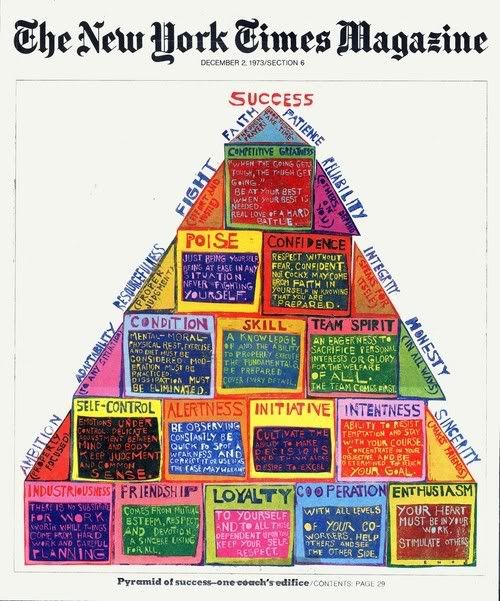
Any Hill shared his view for life successes and happiness based upon principles he learned from Coach John Wooden. Andy was a member of three consecutive NCAA Championship basketball teams under the guidance of Coach Wooden. Any later served as President of CBS Productions from January 1991 through April 1996 and was responsible for successful shows including Touched by an Angel, Dr. Quinn: Medicine Woman, Walker Texas Ranger, etc.
I enjoyed learning about Coach Wooden's pyramid of success and used it to inspire boys to be men and better citizens. I have included it below:

General Colin L. Powell
General Powell was the conference keynote speaker. He was a last minute replacement for Former Prime Minister Tony Blair who was called to Egypt as a result protests and unrest in that country. Tony Blair brought a round of laughter from the crowd of over 2,500 when he said in a recorded message that he thought he would tackle something easy like peace in the Middle East after he retired as prime minister.
Powell was humorous and thoughtful as he shared experiences from his career and life. Powell shared his thoughts about President Reagan's optimism in America and his belief in Americans and wished he "could put all of Reagan's optimism in a bottle and pour it over the heads of politicians in Washington."
I loved the story of his favorite hot dog vendor in New York City and how he would always stop to get a hot dog when he was in public service. Powell shared that when he was in New York City after he left public life he stopped to get a hot dog. After pulling cash from his wallet to pay for the hot dog, the vendor, who came to this country 40 years before, refused to take his money and told Powell the following: "I know who you are. You are Colin Powell. I've been paid. America has paid me. You paid me with your public service. I have taken the opportunity that you have given me, and I am grateful."
Professor Jeremy Siegel
Dr. Siegel is a professor at the University of Pennsylvania's Wharton School of Finance and author of Stocks for the Long Run. He was very dynamic and shared some charts and thoughts.
One chart showed what $1 after inflation would have grown to in various asset classes from 1802 through 2010. It was surprising to see that Gold grew from $1 to $4.02 and U.S. Stocks grew from $1 to $699,088. He believes that "people who recently bought gold are going to be disappointed in five years."
He also showed a chart of U.S. stocks going all the way back to the 1800s. This chart showed a trend line for U.S. stock prices going back to the 1850s with annual price fluctuations above and below the line. If stock prices were above or below the trend line during various years, the prices were eventually drawn back to the trend line. Siegel believes that as of December 31, 2010, the U.S. was 20% below it's long term trend. During the Financial Crisis and Great Recession the U.S. stock market fell to 39.4% below the trend line--the fifth largest deviation during this period of time.
Siegel shared many other statistics but it was clearly obvious that he believed in "Stocks for the Long Run."
Alan Simpson and Erskine Bowles
Former Senator Alan Simpson and former White House Chief of Staff Erskine Bowles shared their experiences and thoughts as co-chairs of the National Commission on Fiscal Responsibility and Reform. Simpson started the discussion by saying they had 14 reasons to inject themselves into the deficit-reduction debate. "He [Bowles] has eight grandchildren and I have six."
According to Simpson and Bowles balancing the budget is a matter of addressing the substantive areas of Medicare, Medicaid, Social Security and defense. Simpson said, “If you don’t cut these, you have to cut everything else by 75%.”
The Commission’s report addresses getting rid of loopholes, broadening the base and simplifying the tax code. They believe that by getting rid of the $1.1 trillion of earmarks in the tax code, “we can take the rates to 8 percent up to $70,000, 14 percent up to $210,000 and 23 percent above that, with a corporate tax rate of 26 percent.” At that point, they agree, America will again be a great place to start and grow a business.
Craig Alexander
TD Ameritrade Chief Economist Craig Alexander shared his insights. He reminded us that two years ago the media was talking 24/7 about the long-term global depression and failed to predict we would be where we are today.
He made the point that "we are a year and a half into recovery but consumers and businesses clearly don't feel like they've reached the far end of the valley." He said said it typically takes twice as long to recover from a financial crisis than it would take from a normal recession.
He felt that inflation would not be an issue for several years due to the huge overhang of inventory at the present time. But he thought the job market would continue to disappoint since you need 200,000 new jobs each month to keep unemployment from rising. And with the people leaving the labor market the REAL unemployment rate was closer to 16%. However, he was not concerned about unemployment as a predictor of the economy since unemployment is a lagging indicator of the economy and stock market.
Alexander said the consensus among economists is for 3% growth of U.S. GDP this year and next year. However, Alexander felt this was too conservative and was projecting a 3.5% to 4% growth.
For the most part, Alexander agree with Professor Siegel and felt that investors who are not participating in the market will be kicking themselves.
Dewitt Jones
We also had the privilege of listening to Dewitt Jones, a motivational speaker and former photographer for National Geographic. What made him unique was that he shared his photographs and stories behind the photographs as he spoke on his theme of "falling in love with the world" and "celebrating what is best in the world."
If you ever have the chance to listen to him, don't pass on it. In the meantime, you can see many of his beautiful photographs by clicking on this web site.
Andy Hill
Any Hill shared his view for life successes and happiness based upon principles he learned from Coach John Wooden. Andy was a member of three consecutive NCAA Championship basketball teams under the guidance of Coach Wooden. Any later served as President of CBS Productions from January 1991 through April 1996 and was responsible for successful shows including Touched by an Angel, Dr. Quinn: Medicine Woman, Walker Texas Ranger, etc.
I enjoyed learning about Coach Wooden's pyramid of success and used it to inspire boys to be men and better citizens. I have included it below:
I also loved the following poem that Coach Wooden would often recite:
No written word, no spoken plea
Can teach our youth what they should be,
Nor all the books on all the shelves.
It's what the teachers are themselves.
Monday, February 14, 2011
Qualified Charitable Distributions
Perhaps lost in all the posturing about what would become of the Bush tax cuts was a valuable extension for qualified charitable distributions. The 2010 Tax Relief Act extended the tax-free distributions from Individual Retirement Accounts (IRAs) for charitable purposes through 2011, i.e., Qualified Charitable Distributions (QCDs).
Briefly, we all know distributions from IRAs must be included in gross income in the year of distribution, and income taxes must be paid on the taxable portion of distributions. A QCD allows IRA owners and beneficiaries age 70½ and older to make tax-free distributions of otherwise taxable dollars from traditional IRAs to qualified charitable organizations. These distributions are also allowed to be made from SEP IRAs and SIMPLE IRAs as long as no employer contributions were made for the same tax year. These QCDs are limited to $100,000 per year, per IRA owner or beneficiary, and the check has to be payable directly to the eligible charity.
I will be sharing more details about this excellent charitable planning opportunity in the coming months. If you are interested in learning more, please consult your financial advisor.
Briefly, we all know distributions from IRAs must be included in gross income in the year of distribution, and income taxes must be paid on the taxable portion of distributions. A QCD allows IRA owners and beneficiaries age 70½ and older to make tax-free distributions of otherwise taxable dollars from traditional IRAs to qualified charitable organizations. These distributions are also allowed to be made from SEP IRAs and SIMPLE IRAs as long as no employer contributions were made for the same tax year. These QCDs are limited to $100,000 per year, per IRA owner or beneficiary, and the check has to be payable directly to the eligible charity.
I will be sharing more details about this excellent charitable planning opportunity in the coming months. If you are interested in learning more, please consult your financial advisor.
Monday, February 7, 2011
Power to the People: U.S. Shareholders Have a Say on Corporate Pay
Starting on January 21, 2011, shareholders of U.S. companies will be able to give a thumbs up or a thumbs down to executive pay packages. You may remember that the "say on pay" vote was first introduced as a safeguard when U.S. financial institutions dubbed "too big to fail" received federal bailout funds thanks to the Troubled Asset Relief Program (TARP). Today, the Dodd-Frank Wall Street Reform and Consumer Protection Act requires that all public companies conduct say-on-pay votes at least once every three years. According to Say on Pay: Will U.S. Shareholders Give Executives the Thumbs Up on Compensation?, an article published in the online business journal Knowledge@Wharton, shareholders will also be asked for their views on golden parachute awards after a merger or acquisition and pension funds and other large institutional investors that cast ballots must disclose how they voted.
In the article, Wayne Guay, a Wharton accounting professor who consults on executive compensation plans, questions whether the new voting system can help improve pay packages. In his view, any analysis of pay packages by institutional investors would be trivial when compared to the work of various corporate boards. Interestingly, the article includes data from Towers Watson, a compensation advisory firm, that backs Professor Guay. According to Towers Watson, of the companies that voluntarily adopted say-on-pay voting in advance of Dodd Frank, only three companies failed to receive majority support for their compensation programs in 2010, and no company failed to receive majority support in 2009.
In my view, Wharton Professor Micahel Useem sums the pros and cons of the new law nicely. While he says the big benefit will be the increased transparency into the design of executive pay structures, he cautions that if boards become too focused on compensation issues, they may fail to dedicate the time necessary for long-term corporate planning.
In the article, Wayne Guay, a Wharton accounting professor who consults on executive compensation plans, questions whether the new voting system can help improve pay packages. In his view, any analysis of pay packages by institutional investors would be trivial when compared to the work of various corporate boards. Interestingly, the article includes data from Towers Watson, a compensation advisory firm, that backs Professor Guay. According to Towers Watson, of the companies that voluntarily adopted say-on-pay voting in advance of Dodd Frank, only three companies failed to receive majority support for their compensation programs in 2010, and no company failed to receive majority support in 2009.
In my view, Wharton Professor Micahel Useem sums the pros and cons of the new law nicely. While he says the big benefit will be the increased transparency into the design of executive pay structures, he cautions that if boards become too focused on compensation issues, they may fail to dedicate the time necessary for long-term corporate planning.
Subscribe to:
Posts (Atom)


 Posts
Posts


